
Black Petals
Horror/Science Fiction Magazine
July 15th, 2026
Issue # 116

A Bar With No Name: Fiction by Dale Scherfling
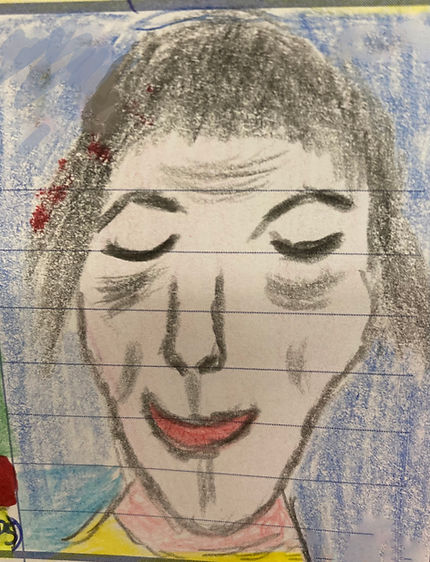
Art by Luis Cuauhtémoc Berriozábal © 2026
A Bar with No Name
Dale Scherfling
I was sitting in a classroom, though I couldn't remember registering for the course. The instructor was handing back exams from a test I had no memory of taking. He dropped a paper onto my desk. A 78% was circled in red ink at the top. He tapped the page with the dull end of his pencil, pointing to a large, empty zero.
"You haven't turned in a single journal entry," he said. His voice was flat, like a radio tuned to a dead station. "We’re halfway through the semester."
"I’m a writer," I told him. "I write every day. It’s what I do. But I don’t have any recollection of this assignment."
We stared at each other. The classroom clock ticked with a heavy, mechanical thud. Above us, a fluorescent light sputtered, humming a low, irritating B-flat.
"Can I catch up?"
"You can't reclaim lost time," he said softly. "But if you complete every entry from tonight onward, you might survive."
He moved away. I turned to the two men sitting next to me. Their faces were vaguely familiar, the way people's faces look when you encounter them in a train station just before waking up.
"Did you know about the journal?" I asked.
They both nodded.
"First night," the one on the left said.
"And you've been keeping it? Every single day?"
The other smiled, a small, secretive expression. "Well. Not every day. Nobody lives their life every day."
The three of us left the building to get a beer.
We drove south of the university, out toward an extension campus situated on a patch of neglected land. It had been sixty-two years since I graduated from San Diego State. Hail Montezuma, I thought, squeezed into the front seat between them. The vinyl was cracked and smelled faintly of old peppermint.
We pulled up to the curb in front of a plain wooden door. There was no neon sign, no name, no indication that anything existed behind it. Inside, however, a stereo was playing a pristine vinyl pressing of a 1950s jazz trio—maybe Red Garland. The room was deep and shadowed, with a long mahogany bar. And right in the center, inexplicably, sat an enormous bed. It was three times the size of a standard king, piled high with velvet pillows. Two young women in frilly nightgowns were lounging on it, reading paperbacks as if it were the most natural thing in the world. The bed was so high its surface was level with my chest.
We sat at a small corner table. A waiter appeared, carrying a tray.
"No need to card you," he said, looking at my face. His eyes were entirely devoid of judgment. "San Diego State?"
"Class of '64," I said.
"Goddamn," he said, shaking his head. "How old are you anyway?"
"Ninety."
A few people at the bar turned to look at me. My two companions stared, too, as if noticing the lines on my face for the first time. The waiter pulled a pair of reading glasses from his pocket and studied my driver's license anyway. He let out a dry chuckle.
"You’re only eighty-nine."
"Close enough," I said. "Ninety at midnight."
He brought three bottles of Coors Light, cold and sweating heavily in the dim light. A moment later, the owner of the bar approached. He was carrying a massive, unframed canvas covered in abstract slashes of brilliant orange and deep crimson. Along the borders, the black paint was still wet, glistening like oil.
"A birthday present," the owner said, leaning it against our table.
I looked at the canvas. It was beautiful, but it was massive. How am I supposed to carry this onto an airplane? I wondered. How does one transport a piece of someone else's mind?
At the next table, a young woman with dark, gothic eyeliner sat next to a boyfriend who was cradling an acoustic guitar.
"Does anyone else here play?" the boy asked the room.
"I play a little guitar," I said.
He grinned, shifting his weight. "A little bit, or a small guitar?"
Before I could answer, a hand reached out from the shadows to my left. It didn't seem to belong to anyone. The hand pressed a cardboard cereal box into my palms.
"Happy Birthday," a voice whispered.
I squeezed it. The box was full. I opened the top flap and tipped a small amount onto the dark wood of the table—a fine, white, powdery substance. One of my companions leaned forward, inhaled a small amount through his nose, and immediately slammed back into his chair, his eyes wide.
"Holy shit," he breathed. "That's remarkably strong."
I didn't want the powder. I carried the box to the bar and asked the owner if I could trade it for something less absolute. He hefted the box, frowned, and then reached under the counter to produce a leather dice cup. He shook it once, a hollow, rhythmic sound, and extended it toward me. I reached in and pulled out a single die. It was deep purple and coated in a fine dust of sugar. I turned it over in my fingers, looking for the dots. There were none. The faces were completely blank.
"That’s your prize," the owner said, watching me. "Eat it."
I placed the die on my tongue. It tasted slightly stale, like a candy forgotten in a drawer since the winter of 1974.
Almost immediately, the edges of the room began to bloom into swirling, vibrant colors. The fatigue in my joints vanished, replaced by a cool, clean current of energy. I felt exactly twenty-five years old again. I walked back to my table, my feet barely touching the floorboards.
The hand reappeared from the shadows, this time holding a cigar-box guitar. It wasn't the crude, four-string folk instrument you usually see; it was a professionally crafted six-string instrument, lacquered and heavy. I opened the wooden lid. Glued to the inside was a tasteful, monochromatic nude photograph of the gothic girl from the next table. She was already smiling at me, handing me a quarter-inch jack connected to her boyfriend’s amplifier.
The boyfriend nodded. We began to play.
I didn't know the song. It didn't have a title or a chord progression that I recognized, but it didn't matter. Whatever notes I chose, they slotted into the empty spaces of the music perfectly, like pieces of a perfectly machined puzzle.
I handed my iPhone to one of my friends. "Take some photos," I told him. "Make sure you get the guitar."
Then I stepped forward to solo. I played Malagueña. First, I stayed on the top three strings, keeping the notes high, bright, and detached—the way the world feels when you are young and nothing has broken yet. Then I dropped down to the lower strings, searching for something deeper, darker, and more complicated. It was the way the song is supposed to sound when you’ve lived long enough to understand that most things in this world are lost forever.
Someone stepped out of the gloom and pressed a crisp five-dollar bill into my palm.
For a brief, suspended pocket of time, I possessed everything. I had the music, the strange, anonymous generosity of the room, and the weight of the guitar against my ribs. It was ninety years of existence distilled into six steel strings inside a bar without a name. I knew, with absolute certainty, that I never wanted to put the instrument down.
Then I woke up.
The bedroom was dark and quiet. I reached over to the nightstand and checked my iPhone's camera roll.
There were no photos, of course. Only the usual images of the dog and old manuscripts.
I lay there in the dark, listening to the silence of the house. I am a writer. I should have known better. The only way to hold onto a dream, to keep it from dissolving into the atmosphere like steam, is to commit it to paper before the world rushes back in. That was what the journal was for.
I closed my eyes, but the music was completely gone.
Dale Scherfling is a newspaper veteran of 30 years, serving as a sportswriter, columnist, editor, and photographer and a retired Navy journalist and photographer. His work has appeared in Third Act Magazine, Does It Have Pockets Magazine, Lost Blonde Literary, All Hands Magazine, Pacific Crossroads, Daily Californian, Naval Aviation Magazine, Propeller Magazine, and Buckeye Guard Magazine. He is the recipient of three U.S. Army Front Page Journalism Awards. He is also a college lecturer and photography and music instructor.
Luis Cuauhtémoc Berriozábal lives in California and works in the mental health field in Los Ángeles. His artwork has appeared over the years in Medusa’s Kitchen, Nerve Cowboy, The Dope Fiend Daily, and Rogue Wolf Press, Venus in Scorpio Poetry E-Zine.